
Healthy Boundaries, Healthier Workplaces, and More Good Days Together
Workplace Well-Being Is About More Than Wellness Programs
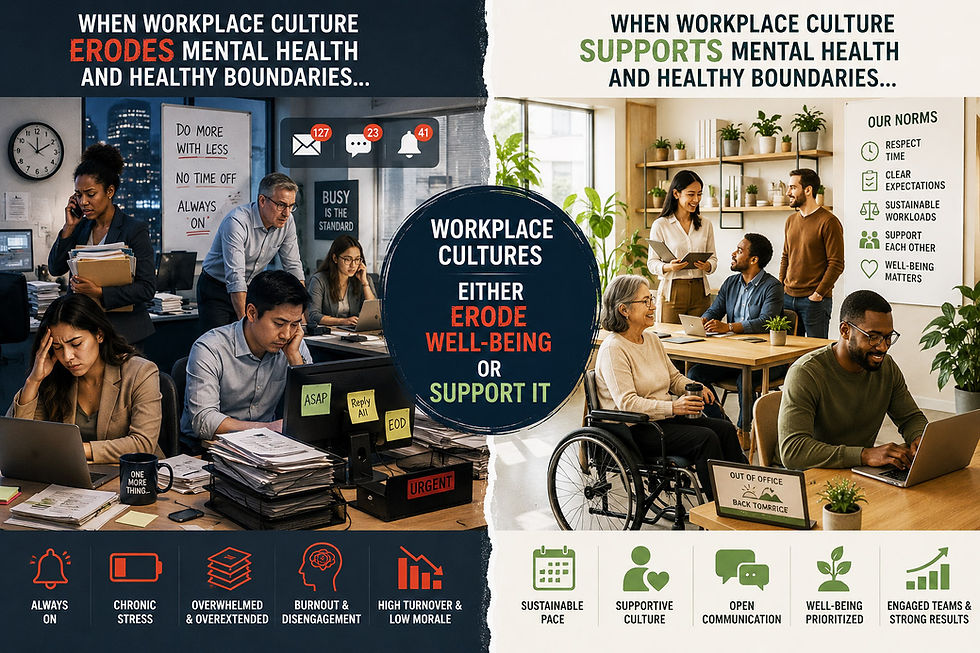
When organizations talk about workplace well-being, the conversation often centers on stress management, wellness initiatives, or productivity tools. But one of the most overlooked contributors to employee mental health is the presence, or absence, of healthy boundaries within workplace culture.
Healthy workplace boundaries are not about employees caring less or avoiding accountability. They help create the conditions for sustainable performance, healthier communication, stronger collaboration, and reduced burnout.
What Happens When Boundaries Are Weak
Without healthy boundaries, many workplaces drift into chronic overextension. Employees feel pressure to remain constantly available, absorb increasing workloads, avoid saying no, and continue producing regardless of exhaustion.
Over time, this contributes to emotional fatigue, resentment, disengagement, communication breakdowns, and burnout.
What Healthier Workplace Cultures Tend to Include
Healthier workplace cultures often include:
clear expectations and communication,
realistic workloads,
respect for time and capacity,
psychological safety,
encouragement of recovery and self-care,
and leadership practices that support sustainability rather than perpetual crisis mode.
Leadership Sets the Tone
Workplace boundaries are not solely the responsibility of employees. Organizational culture is shaped significantly by leadership behavior and by what is consistently modeled, rewarded, and normalized.
Employees often pay far more attention to workplace behavior than workplace slogans.
If overwork, constant accessibility, and self-sacrifice are continually rewarded, employees quickly learn that boundaries may not actually feel safe, regardless of how often wellness is discussed.
A Reflection on Workplace Culture
One useful way to reflect on workplace culture is to examine the messages employees receive, both explicitly and implicitly, about boundaries, workload, responsiveness, and well-being.
As you review the table below, consider where your organization, leadership style, or team culture tends to fall most often. The goal is not perfection, but awareness. Burnout and disengagement are rarely caused by one difficult week. More often, they emerge from repeated cultural patterns that gradually erode balance, trust, and emotional well-being.
When workplace culture erodes mental health and healthy boundaries… | When workplace culture supports mental health and healthy boundaries… |
Employees feel pressure to remain constantly available and responsive. | Employees are encouraged to maintain sustainable availability and recovery time. |
Workloads continually expand without adjustment of priorities or resources. | Expectations and workloads are evaluated realistically and adjusted when needed. |
Employees fear being perceived as weak or uncommitted if they ask for help. | Psychological safety allows employees to ask for support without fear of judgment. |
Burnout is normalized or treated as a badge of commitment. | Sustainability and long-term well-being are valued alongside performance. |
Leaders unintentionally reward overwork and constant accessibility. | Leaders model healthy boundaries, balance, and respect for personal time. |
Employees feel unable to say no, push back, or discuss capacity concerns. | Employees are encouraged to communicate openly about workload and capacity. |
Time off is subtly discouraged or interrupted by ongoing work demands. | Rest, vacation time, and recovery are respected as important to well-being and performance. |
Employees feel valued primarily for output and productivity. | Employees are recognized as human beings whose well-being contributes to organizational success. |
Final Thoughts
Creating more good days together requires more than wellness messaging. It requires intentional leadership and workplace cultures where people can contribute meaningfully without sacrificing themselves in the process.
Healthy organizations understand that employee well-being and organizational performance are not opposing forces. They are deeply connected.
If your organization is struggling with burnout, chronic stress, disengagement, or communication challenges, it may be time to look not only at workload, but at the workplace culture and boundaries shaping the employee experience.
At Cutts Consulting, we help leaders and organizations cultivate healthier, more sustainable workplace cultures through leadership development, communication training, team building, and employee well-being initiatives.
To learn more, contact Dr. Nicole Cutts


Comments