
Burnout Isn’t an Employee Weakness. It’s a Leadership Design Failure.

Burnout Isn’t an Employee Weakness. It’s a Leadership Design Failure.
Employees who report feeling burned out are 2.6 times more likely to be actively seeking another job and 63% more likely to take a sick day, according to Gallup’s workplace research.
Burnout is not just an employee well-being concern. It is a measurable organizational risk — affecting retention, performance, and stability.
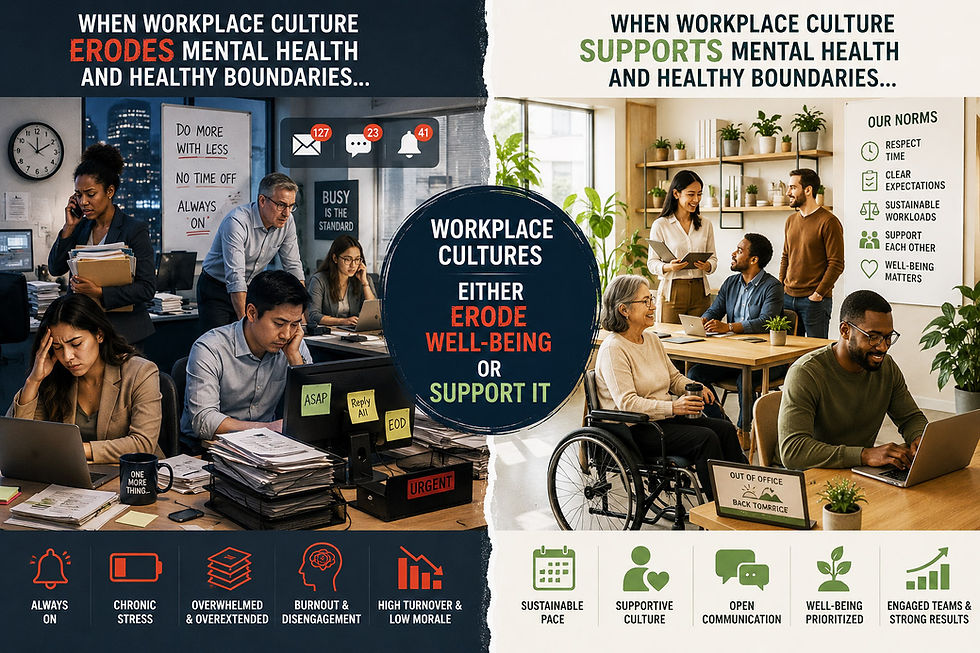
And despite the common refrains — manage your time better, work smarter, be more resilient — burnout is rarely the result of individual inefficiency.
Gallup’s findings show that the primary drivers of burnout include unmanageable workload, unclear expectations, inconsistent communication, and lack of managerial support.
Those are not time-management problems.
They are leadership design variables.
Burnout persists not because employees fail to optimize themselves — but because the system in which they operate is misaligned.
Burnout is not a workforce weakness.It is a leadership design flaw.
I. What Burnout Actually Is
The World Health Organization classifies burnout as an occupational phenomenon resulting from chronic workplace stress that has not been successfully managed.
Research consistently identifies workload, role ambiguity, lack of control, and insufficient support as primary contributors.
Burnout emerges from how work is structured.
II. Leadership Behavior Is How Design Becomes Reality
Large-scale research conducted by the Mayo Clinic shows that employees who rate their immediate supervisors highly are significantly less likely to report burnout.
Systematic reviews further show that supportive and empowering leadership styles reduce burnout, while disengaged leadership increases it.
Leadership behavior is not separate from system design — it is how design becomes operational.
Behavior is the delivery mechanism of design.
III. Leaders Control the Demand–Resource Equation
The Job Demands–Resources (JD-R) model explains that burnout occurs when job demands consistently exceed job resources.
Leaders influence both sides of that equation.
When demand escalation becomes chronic and resources remain static, burnout is predictable.
IV. When Leadership Itself Is Strained
Research indicates that leader burnout reduces transformational leadership behaviors and increases reactive management patterns.
Strained leaders embed strain into culture.
Burnout becomes systemic.
V. What About Resilience and Wellness?
Resilience training and wellness strategies matter. They help individuals regulate stress and recover more effectively.
But resilience without structural alignment produces diminishing returns.
Burnout mitigation works best when both levels are addressed:
Individual capacity building
Organizational design recalibration
VI. If Burnout Keeps Recurring, Redesign the System
If burnout is persistent in your organization, examine:
Where demands are outpacing capacity
Where accountability exceeds authority
Where span of control is unrealistic
Where managers were promoted without leadership development
Where performance metrics reward exhaustion instead of sustainability
That fourth point connects directly to the crisis I explored in The Accidental Manager.
When leadership capability lags behind leadership responsibility, strain spreads downward.
Burnout is not random. It is feedback.
Leaders should treat burnout as a systems issue — not a morale issue.
Through leadership coaching, team coaching, and structured organizational assessment, organizations can identify demand–resource imbalances and redesign the conditions that produce chronic strain.
At Cutts Consulting, I work with leaders and executive teams to strengthen leadership capability, recalibrate workload design, and align organizational structure with strategy — so resilience efforts are supported by the system, not undermined by it.
Burnout is a signal.
The question is not whether it exists.
The question is whether you are willing to redesign what created it.


Comments